How Luxury Cat Boarding Improves Feline Comfort and Health
Planning a trip while your cat waits at home is one of those slow-burn worries that doesn't fully quiet until you're back at the door. For cat owners in the San Mateo Bay Area, the question isn't just "who will feed her" - it's "will she be okay, really okay, without me."
Luxury cat boarding is a purpose-built care environment designed specifically around feline behavioral needs - not adapted from dog facilities or general pet care models. It reduces environmental stressors, maintains consistent health monitoring, and provides enrichment calibrated to how cats actually experience space, sound, and social interaction.
Key Takeaways
- Cats experience stress differently than dogs - purpose-built feline environments address the specific triggers that general pet boarding cannot.
- Cleanliness protocols in dedicated cat facilities directly reduce the transmission risk of respiratory illnesses like feline herpesvirus and calicivirus.
- Enrichment and space design matter more than square footage alone - how a space is structured affects feline stress levels measurably.
- Vaccination verification (including FVRCP) is a non-negotiable health safeguard in quality cat boarding, not a formality.
- Professional monitoring catches early behavioral and health changes that owners - and general boarding staff - often miss.
- The Cats' Inn was recently recognized in the Best of San Mateo Area awards as Best Place to Board Pets (Winner) and among the area's Best Cat Sitters (Winner), reflecting its reputation for specialized feline care and client trust.
Why Do Cats Struggle in Standard Boarding Environments?
Most boarding facilities were designed with dogs in mind. Cats were added later, often as an afterthought - smaller kennels, adjacent to barking, with shared air circulation and unfamiliar smells layered on top of each other.
The result is a cat that spends its entire stay in a state of low-grade threat response.
Cats are territorial by nature. Feline behavioral research consistently shows that unfamiliar environments trigger a stress cascade - elevated cortisol, reduced appetite, suppressed immune function - that can persist for days even after the stressor is removed. This isn't temperament. It's biology.
The real problem isn't that cats dislike being away from home. It's that most boarding environments are actively structured in ways that conflict with how cats regulate safety.
A cat that stops eating on day two of a standard boarding stay isn't difficult. She's responding to an environment that reads as unsafe - too loud, too open, too unpredictable. Understanding this mechanism is the first step to understanding why purpose-built feline care produces measurably different outcomes.
What Actually Makes a Cat Boarding Environment "Luxury"?
Luxury cat boarding is not about aesthetics. It is about design specificity - every element of the environment calibrated to reduce feline anxiety and support natural behavior.
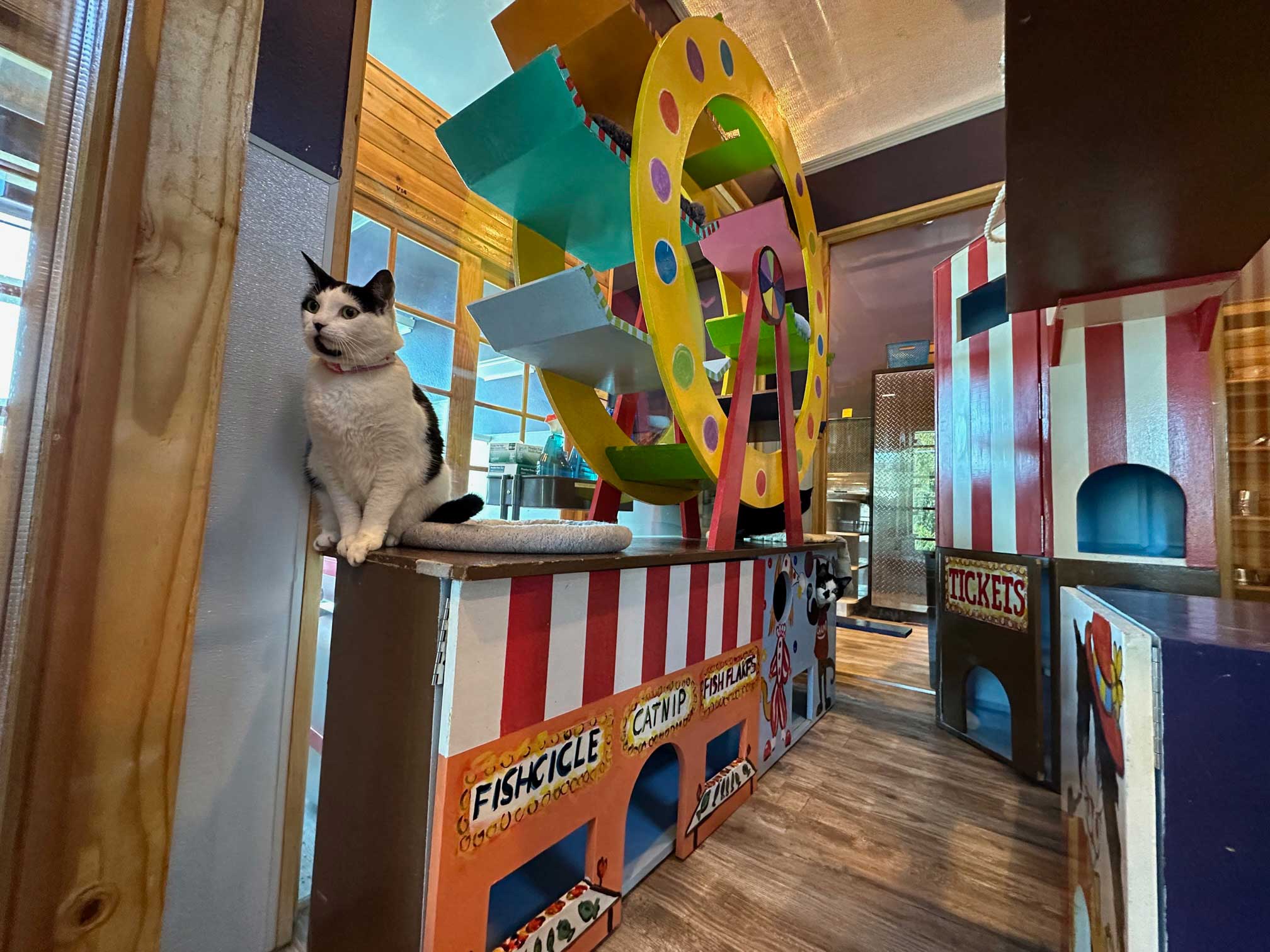
At The Cats' Inn in Belmont, the 3,400-square-foot facility is organized around eight themed playrooms, each built to give cats vertical space, visual separation, and sensory variety without sensory overload. There are no dogs on the premises. Ever. That single fact changes the acoustic and olfactory environment entirely.
That commitment to feline-specific care has also earned recognition from the local community. In the recent Best of San Mateo Area awards, The Cats' Inn was named Best Place to Board Pets (Winner) and recognized among the area's Best Cat Sitters (Winner). While awards alone don't determine quality, they do reflect the experiences of cat owners who have entrusted their companions to specialized feline care.
Here is what separates purpose-built feline environments from general pet boarding:
Feature | General Pet Boarding | Luxury Cat Boarding |
Species separation | Mixed or partially separated | Cats only - no dog presence |
Sound environment | Barking, high activity | Quiet, controlled, cat-appropriate |
Space design | Kennel-based, limited vertical | Themed rooms, climbing, hiding options |
Staff expertise | General animal care | Feline behavior and health focused |
Health monitoring | Basic observation | Daily behavioral and appetite tracking |
Vaccination standards | Variable | FVRCP and rabies verification required |
Medication administration | Limited or unavailable | Full support, per owner instructions |
The mechanism behind this matters. Vertical space isn't a luxury perk - it allows cats to self-regulate perceived threat by choosing elevation. Hiding options aren't indulgence - they give cats control over visibility, which directly reduces cortisol response. These aren't design preferences. They are behavioral tools.
A cat that can choose where to be - high or low, visible or hidden - is a cat that feels safe. That choice is the foundation of everything else.
How Does Cleanliness Affect a Cat's Health During Boarding?
This is the question most owners don't think to ask until something goes wrong.
Upper respiratory infections are the most common health complication in boarding environments. Feline herpesvirus (FHV-1) and feline calicivirus - the pathogens targeted by the FVRCP vaccine - spread through shared surfaces, airborne droplets, and direct contact. In facilities with inadequate sanitation protocols or mixed-species populations, transmission risk increases significantly.
Cleanliness in a quality cat boarding facility is a clinical function, not a housekeeping one.
At The Cats' Inn, sanitation protocols are structured around preventing cross-contamination between guests. Vaccination verification - including current FVRCP and rabies documentation - is required before any cat enters the facility. This isn't bureaucratic gatekeeping. It protects every cat currently in residence.
The FVRCP vaccine covers feline viral rhinotracheitis, calicivirus, and panleukopenia - three of the most communicable feline illnesses. Requiring it for boarding admission is one of the most straightforward health safeguards a facility can implement. Facilities that skip this step are making a risk tradeoff that affects every guest, not just the unvaccinated one.
The Feline Comfort Scoring Framework: How to Evaluate Any Boarding Environment
The Feline Comfort Scoring Framework is a five-factor evaluation tool for assessing whether a boarding environment is genuinely built for cat wellbeing - not just marketed that way.
Use this when: comparing boarding options, touring a new facility, or deciding between in-home and facility care.
Not useful when: evaluating emergency or veterinary boarding, where medical need overrides comfort optimization.
Score each factor 1-3:
- Species separation - Is it cats-only (3), cats separated from dogs (2), or mixed (1)?
- Vertical and hiding space - Dedicated climbing and concealment options (3), partial (2), kennel-only (1)?
- Vaccination verification - FVRCP and rabies required (3), rabies only (2), not required (1)?
- Staff feline expertise - Cat behavior trained (3), general animal care (2), rotating staff (1)?
- Individual monitoring - Daily behavioral tracking per cat (3), group observation (2), check-ins only (1)?
Score 13-15: Purpose-built feline environment. Proceed with confidence.
Score 9-12: Acceptable with caveats - ask specific questions about the gaps.
Score below 9: The environment is not optimized for feline wellbeing. Consider alternatives.
Does Professional Monitoring Actually Change Health Outcomes?
Yes. And the mechanism is specific.
Cats are behaviorally designed to mask illness. In the wild, showing vulnerability attracts predators - so cats suppress visible signs of discomfort until a condition is advanced. This means that changes in appetite, litter box use, grooming behavior, or social withdrawal are often the earliest detectable signals of a health issue.
Staff trained in feline behavior recognize these signals. Staff trained in general animal care often don't - not because they're inattentive, but because the behavioral baseline for cats is different and subtler than for dogs.
The cat who ate half her breakfast instead of all of it is telling you something. Whether anyone hears it depends entirely on who's watching.
At The Cats' Inn, daily monitoring tracks each whiskered guest individually - appetite, activity, social behavior, and any physical changes. Medication is administered exactly as directed by the owner. This level of attentiveness is the difference between catching something early and discovering it after you return home.
One practical example: a cat boarding for a week-long stay began showing reduced appetite and increased hiding behavior on day three. Staff flagged the change, contacted the owner, and the owner authorized a veterinary check - catching a mild upper respiratory issue before it escalated. That outcome depends entirely on having someone present who knows what "normal" looks like for that specific cat.
Is Luxury Cat Boarding Right for Every Cat?
Honest answer: not always.
Some cats - particularly those with severe anxiety, medical complexity, or extreme territorial sensitivity - may do better with in-home care, where their own environment provides the baseline of safety that no external facility can fully replicate. The Cats' Inn offers in-home sitting services for exactly this reason: a trained sitter visits your home on a scheduled basis to provide feeding, litter maintenance, playtime, and attentive observation in the cat's own space.
Facility boarding is not the right choice when:
- A cat has a medical condition requiring veterinary-level monitoring beyond medication administration
- A cat's anxiety is so severe that environmental novelty itself is the primary stressor
- A cat has never been away from home and the owner prefers a gradual introduction to outside care
This is not a failure of the facility. It is an honest matching of service to need. Quality care providers say this plainly rather than booking every cat regardless of fit.
The facilities that consistently earn owner trust are often those willing to prioritize appropriate care over occupancy. The Cats' Inn's recent recognition as Best Place to Board Pets (Winner) and one of the area's Best Cat Sitters reflects that philosophy, matching services to a cat's individual needs rather than treating every situation the same way.
Luxury cat boarding works because it's designed for cats. It doesn't work for every cat in every situation - and any facility that claims otherwise is optimizing for occupancy, not outcomes.
Frequently Asked Questions
How is luxury cat boarding different from regular cat boarding?
Luxury cat boarding is purpose-designed around feline behavioral needs - cats-only environments, vertical space, individual monitoring, and staff trained specifically in feline care. Regular boarding often adapts general pet care infrastructure to cats, which means shared air, proximity to dogs, and staff without specialized feline training. The difference shows up in how cats eat, sleep, and behave during their stay.
What vaccinations does my cat need before boarding?
Most quality cat boarding facilities, including The Cats' Inn, require current FVRCP (feline viral rhinotracheitis, calicivirus, and panleukopenia) and rabies vaccinations. These protect your cat and every other cat in the facility from the most common and communicable feline illnesses. Bring your vet's vaccination records when you inquire about a reservation.
How do I know if my cat is stressed during boarding?
Signs of boarding-related stress include reduced appetite, hiding more than usual, changes in litter box behavior, and decreased grooming or over-grooming. In a quality facility, trained staff track these behaviors daily and contact owners when patterns shift. If a facility can't tell you specifically how they monitor individual cats, that's a gap worth asking about.
Can my cat get sick from boarding with other cats?
Risk exists in any shared environment, but it is significantly reduced in facilities with strict vaccination requirements, proper sanitation protocols, and species-only populations. Requiring FVRCP vaccination is the single most effective preventive measure. Facilities that skip vaccination verification are accepting a risk that responsible ones don't.
What happens if my cat needs medication during boarding?
At The Cats' Inn, trained staff administer all medications exactly as directed by the owner - oral medications, topical treatments, and scheduled doses. When inquiring about any boarding facility, ask specifically how medications are tracked and administered, and whether there is an additional fee involved.
Is an in-home cat sitting better than boarding for anxious cats?
For cats with significant territorial anxiety or medical complexity, in-home sitting often produces less disruption - the cat stays in its known environment, which provides a baseline of safety no external facility can fully replicate. The Cats' Inn offers in-home visits that include feeding, litter care, playtime, and attentive observation, making it a strong option for cats who do better in familiar surroundings.
How do I choose between The Cats' Inn and a general pet boarding facility?
The core question is whether the facility was built for cats or adapted for them. Cats-only environments eliminate the primary stressors - dog sounds, dog smells, shared airflow - that drive anxiety in general boarding. If your cat is sensitive, territorial, or has had difficult boarding experiences before, a purpose-built feline facility is not a premium upgrade. It is a different category of care entirely.
Ready to Book a Stay Your Cat Will Actually Enjoy?
If you've read this far, you already know what you're looking for: a place where your cat is genuinely cared for, not just housed. A place where someone will notice if she doesn't finish her breakfast. A place without barking, without stress, and without you having to wonder.
Schedule your cat's stay with The Cats' Inn today. Visit thecatsinn.net or stop by at 880 Old County Rd, Belmont, CA 94002. Because every purr matters - and yours deserves the best.
About the Author
The owner and operator of The Cats' Inn has dedicated more than 30 years to providing exceptional cats-only boarding, grooming, daycare, and sitting services in Belmont, California. Under her leadership, The Cats' Inn has grown into one of the San Francisco Bay Area's most trusted destinations for feline care, featuring a 3,400-square-foot facility with themed playrooms, luxury accommodations, and specialized grooming services.
Her approach centers on personalized, low-stress care tailored to each cat's individual personality and needs. Under her leadership, The Cats' Inn has been recognized in the Best of San Mateo Area awards as Best Place to Board Pets (Winner), Best Cat Sitters (Winner), and Runner-Up for Best Place to Groom Animals, reinforcing its reputation as one of the Bay Area's leading feline care providers.
References
American Association of Feline Practitioners (AAFP) - Feline vaccination guidelines, including FVRCP recommendations and boarding health standards.
American Veterinary Medical Association (AVMA) - General feline health and behavior resources, including information on stress-related illness in cats.
Cornell Feline Health Center - Research and educational resources on feline upper respiratory infections, including feline herpesvirus and calicivirus transmission.