The Future of Luxury Cat Boarding and Feline Wellness in 2026
Leaving your cat in someone else's care is not a logistical problem - it is an emotional one. The question is never really "will they be fed?" It is "will anyone actually notice if she stops eating?"
Feline wellness boarding is the practice of integrating health monitoring, behavioral enrichment, and stress-reduction protocols into professional cat care environments - moving beyond basic shelter and feeding toward proactive, individualized oversight of a cat's physical and emotional state during their stay. As this approach becomes the new standard in premium facilities, it is reshaping what cat owners across the San Francisco Bay Area should expect from professional feline boarding and wellness care.
Key Takeaways
- Cats experience measurable physiological stress responses in unfamiliar environments; facilities designed around feline behavioral science actively reduce these responses rather than simply manage them.
- Real-time health monitoring - including appetite tracking, litter box observation, and behavioral pattern logging - allows staff to catch early warning signs before they become emergencies.
- A cats-only environment is not a marketing preference; it eliminates a primary stressor for felines, whose stress response is directly triggered by the presence, scent, and sound of dogs.
- Premium feline wellness facilities in 2026 are distinguished by individualized care protocols, not just square footage or amenities.
- Vaccine requirements, including FVRCP, are a structural safety feature - not a formality - because respiratory illness spreads rapidly in group settings.
- The Cats' Inn was recently recognized in the Best of San Mateo Area awards as Best Place to Board Pets (Winner) and among the area's Best Cat Sitters, reflecting its leadership in feline wellness-focused care.
How Does the Right Boarding Environment Support Your Cat's Wellbeing?
Boarding doesn't have to be stressful for cats. Many cats adapt well and enjoy their stay, especially when they're cared for in a quiet, cats-only environment designed around their needs. The key isn't simply boarding, it's choosing a facility that understands feline behavior and creates an environment where cats can feel safe and comfortable.
Cats experience change differently than dogs and may express it through subtle behavioral changes rather than obvious signs of distress. That's why thoughtful facility design, experienced caregivers, and individualized attention play such an important role in helping cats settle in and enjoy their stay.
Rather than focusing only on amenities, cat owners should ask how a facility supports feline comfort, monitors each cat's wellbeing, and creates a calm environment where cats can thrive during their stay.
What Does Health Monitoring Actually Look Like in a Modern Cat Boarding Facility?
Health monitoring in feline boarding is not a clipboard on a cage door. Done properly, it is a structured daily observation protocol that tracks behavioral and physiological indicators across the length of a stay.
At a minimum, a meaningful monitoring protocol includes:
- Appetite and hydration tracking - not just "did the cat eat" but how much, at what time, and whether the pattern changed from day one to day three
- Litter box observation - frequency, consistency, and any signs of straining or blood, which are early indicators of urinary stress
- Behavioral baseline logging - noting whether a cat is hiding more than their intake assessment suggested, engaging with enrichment, or showing signs of respiratory distress
- Medication administration records - with exact dosing, timing, and any observed reactions
The causal mechanism here matters. Monitoring works not because it catches emergencies after they happen, but because it creates a documented behavioral baseline that makes deviations visible early. A cat who ate well on day one and refuses food on day three is telling you something. A facility without a tracking system cannot hear that signal.
Consider a practical scenario: a senior cat with a history of stress-induced urinary issues boards for a seven-day stay. On day two, staff note reduced litter box visits and flag it with the owner. The owner confirms the cat has a history of FLUTD flares under stress. Staff adjust the environment - moving the cat to a quieter room, adding a Feliway diffuser, increasing wet food offerings. By day four, the pattern normalizes. No veterinary visit required. That outcome is only possible when monitoring is systematic, not incidental.
At The Cats' Inn, this kind of individualized health tracking is built into every stay - not offered as an upgrade.
Is a Cats-Only Facility Actually Better, or Is That Just a Marketing Claim?
This is where the contrarian claim needs to be stated plainly: a cats-only environment is not a premium amenity - it is a baseline welfare requirement for cats.
The presence of dogs in a shared facility does not just create noise. It creates olfactory stress. Cats can detect canine scent through ventilation systems, on staff clothing, and in shared spaces. The AAFP's feline-friendly practice guidelines specifically identify multi-species environments as a significant source of preventable stress for cats. The stress response triggered by dog scent activates the same physiological cascade as a direct threat - elevated cortisol, suppressed immune function, behavioral withdrawal.
Most general pet boarding facilities are not poorly run. They are simply designed for a different animal.
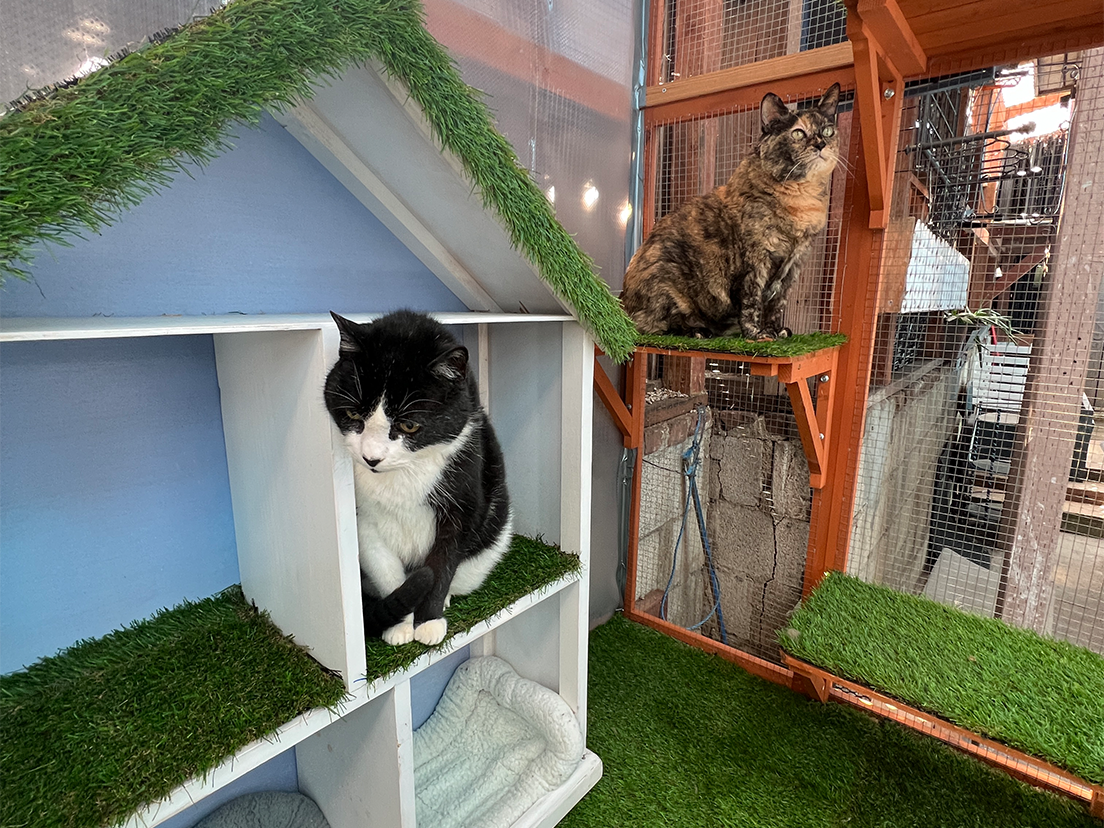
Size alone doesn't determine the quality of a boarding experience. What matters most is how the environment is designed. A spacious, cats-only facility with quiet areas, enrichment, and experienced caregivers gives cats room to explore, relax, and settle in comfortably. That's the philosophy behind The Cats' Inn's thoughtfully designed 3,400-square-foot facility. What matters is how the space is structured - whether it offers vertical territory, visual barriers, predictable routines, and sensory control. Space is a tool. How it is designed determines whether it helps or harms.
The Cats' Inn's 3,400 square feet of cats-only space, organized into eight themed playrooms with individualized environments, is designed around this principle. The square footage is meaningful because of how it is used - not simply because it is large.
That philosophy has resonated with local cat owners as well. In the recent Best of San Mateo Area awards, The Cats' Inn was named Best Place to Board Pets (Winner) and recognized among the area's Best Cat Sitters. While awards alone do not determine the quality of care, they can serve as an independent indicator that a facility's approach is delivering meaningful results for the families it serves.
The Feline Wellness Assessment Framework: How to Evaluate Any Boarding Facility
The Feline Wellness Assessment Framework is a five-point evaluation tool for cat owners comparing boarding facilities - applied before booking, not after.
Use this when choosing between facilities. Skip it if you are comparing on price alone - this framework is designed for owners who have already decided that quality matters and need a structured way to compare.
Assessment Dimension | What to Ask | Green Flag | Red Flag |
Species separation | Are cats and dogs housed in the same building? | Cats-only facility or fully separated airspace | "We keep them in different rooms" |
Health monitoring | How is daily health tracked and communicated? | Written logs, owner updates, named protocol | "We check on them regularly" |
Stress reduction design | What environmental modifications are in place? | Feliway, vertical space, visual barriers, quiet zones | Open-floor kennels, shared play areas |
Vaccine requirements | Is FVRCP required for all boarding cats? | Yes, with documentation verified at intake | Optional or not mentioned |
Staff feline expertise | What training do caregivers have in feline behavior? | Named training, feline-specific certifications | General pet care experience only |
Use this framework to ask questions, not just read brochures. A facility that cannot answer the "health monitoring" question specifically is telling you something important.
What Grooming Has to Do With Feline Wellness (and Why It Is Often Overlooked)
Grooming is not cosmetic. For cats, it is a health maintenance practice.
Matting in long-haired breeds creates skin conditions that escalate quickly. Overgrown nails cause postural problems and, in senior cats, can grow into the paw pad. Ear buildup is a vector for infection. These are not aesthetic concerns - they are clinical ones.
Professional grooming, when performed by staff trained in feline handling, is one of the most underutilized wellness tools available to cat owners.
The mechanism that makes professional grooming different from at-home brushing is not technique - it is the ability to perform a full-body assessment during the process. A trained groomer notices lumps, skin changes, ear odor, and dental concerns that owners often miss because they are not looking systematically. It is a secondary health screen disguised as a spa visit.
The Cats' Inn offers professional grooming services as part of their feline wellness model - not as an add-on, but as an integrated component of comprehensive cat care.
What About In-Home Cat Sitting - When Is That the Right Choice?
In-home cat sitting is the right choice for cats who are highly territorial, have significant anxiety responses to environmental change, or have medical needs that require administration in a familiar setting.
It is not a lesser option. It is a different tool.
In-home visits are most effective when the cat's stress is primarily driven by environmental displacement rather than social isolation. A cat who does well alone but struggles in new spaces is a strong candidate. A cat who requires significant social interaction, or whose owner wants real-time health monitoring and immediate escalation capability, may be better served by a facility-based stay.
The Cats' Inn provides professional in-home sitting visits for cat owners in the San Mateo Bay Area - structured visits that include feeding, fresh water, litter box care, playtime, and basic wellness observation. These are not drop-ins. They are scheduled, documented visits performed by staff familiar with feline behavior.
The honest limitation: in-home visits cannot provide the same level of continuous monitoring as a staffed facility. If a cat has a health event overnight between visits, the response window is longer. Owners with medically complex cats or seniors with known health conditions should weigh this carefully.
What This Means for Cat Owners in Belmont and San Mateo Right Now
The standard for professional cat care is changing. Facilities that offered a clean cage and twice-daily feeding were adequate by the benchmarks of ten years ago. They are not adequate by the benchmarks of 2026.
The single most important shift in feline wellness boarding is the move from reactive to proactive care - from responding to visible problems to monitoring for early signals.
That shift requires staff training, environmental design, and structured protocols. It cannot be retrofitted onto a general pet boarding operation. It has to be built in from the beginning.
Facilities that successfully embrace this proactive model often distinguish themselves through both client outcomes and community reputation. The Cats' Inn's recognition as Best Place to Board Pets (Winner) and among the area's Best Cat Sitters reflects the trust it has earned from cat owners who value specialized feline care, individualized monitoring, and a cats-only environment.
The Cats' Inn has been built around this model for more than 30 years. Some cats may need time to adjust to a new environment before settling into a routine.
Frequently Asked Questions
How do I know if a boarding facility is actually monitoring my cat's health or just saying they do?
Ask for specifics: what gets logged daily, how updates are communicated to owners, and what the protocol is if a cat stops eating. A facility with a real monitoring system can answer these questions immediately and in detail. Vague answers like "we check on them throughout the day" are a signal that monitoring is informal.
Is it really that much better to board my cat somewhere cats-only?
Yes, and the reason is physiological rather than preferential. Cats respond to canine scent as a threat stimulus even without direct contact - through shared air systems, on staff clothing, and in common areas. A cats-only facility eliminates this stressor entirely, which reduces cortisol levels and supports normal eating, grooming, and sleep patterns during the stay.
What vaccines does my cat need before boarding at The Cats' Inn?
FVRCP - which protects against feline viral rhinotracheitis, calicivirus, and panleukopenia - is a standard requirement for boarding because respiratory illness spreads efficiently in group settings. Rabies vaccination is also typically required. Vaccine requirements exist to protect every cat in the facility, including yours.
My cat has never boarded before. How do I prepare her for her first stay?
Bring familiar items - a blanket or toy that carries the scent of home. Provide the facility with a detailed intake profile: feeding schedule, behavioral quirks, any known stressors, and medical history. The more a facility knows about your cat's baseline, the faster they can identify if something is off.
What is the difference between in-home cat sitting and boarding, and how do I choose?
In-home sitting keeps your cat in their familiar environment, which reduces displacement stress. Boarding provides continuous oversight, social enrichment, and immediate response capability if a health issue arises. The right choice depends on your cat's temperament, health status, and how long you will be away.
How do I know if a groomer is actually trained to handle cats specifically?
Ask whether the groomer has feline-specific handling training, not just general pet grooming certification. Cats require different restraint techniques, stress-reading skills, and pacing than dogs. A groomer trained specifically in feline handling will be able to describe their approach to a cat who is anxious or resistant - not just say they are "experienced with cats."
What should I look for in a boarding facility for a senior cat with health issues?
Prioritize facilities with structured daily health monitoring, staff experienced in medication administration, and quiet, low-stimulation environments. Confirm that the facility has a clear protocol for contacting you and your veterinarian if a health concern arises. Senior cats are more vulnerable to stress-induced health events, so the monitoring infrastructure matters more, not less.
If you are planning travel and want to know exactly what your cat's stay at The Cats' Inn would look like - the intake process, the monitoring protocols, the environment - reach out directly and ask. You will get a specific answer, not a brochure.
Learn more about the premium feline care services that earned The Cats' Inn recognition as the Best of San Mateo Area Best Place to Board Pets (Winner) and among the area's Best Cat Sitters.
About the Author
The owner and operator of The Cats' Inn has dedicated more than 30 years to providing exceptional cats-only boarding, grooming, daycare, and sitting services in Belmont, California. Under her leadership, The Cats' Inn has grown into one of the San Francisco Bay Area's most trusted destinations for feline care, featuring a 3,400-square-foot facility with themed playrooms, luxury accommodations, and specialized grooming services.
Her approach centers on personalized, low-stress care tailored to each cat's individual personality and needs. Under her leadership, The Cats' Inn has been recognized in the Best of San Mateo Area awards as Best Place to Board Pets (Winner), Best Cat Sitters (Winner), and Runner-Up for Best Place to Groom Animals, reinforcing its reputation as one of the Bay Area's leading feline care providers.
References
American Association of Feline Practitioners (AAFP) - Feline-friendly practice guidelines covering environmental stress, multi-species housing, and behavioral indicators of feline distress.
American Association of Feline Practitioners (AAFP) - Feline vaccination guidelines, including FVRCP protocol recommendations for cats in group housing environments.