What Cat Owners Should Look for in a Professional Boarding Facility
Leaving your cat behind when you travel is one of those decisions that never feels entirely settled - even after you've made it. The facility looks fine on the website, the reviews seem decent, but something still nags at you on the drive to the airport.
A quality cat boarding facility is one that is exclusively designed for feline behavior, maintains verifiable hygiene protocols, employs staff trained in feline-specific care, and provides a secure, low-stress environment with individual monitoring. The right facility reduces your cat's anxiety - not just your own.
Key Takeaways
- Ask specifically whether the facility is cats-only - shared dog-and-cat spaces create chronic low-grade stress in cats even when animals are physically separated.
- Request a facility tour before booking; any reputable boarding operation will welcome it.
- Confirm that staff are trained in feline behavior and medication administration, not just general pet care.
- Verify vaccination requirements (at minimum FVRCP and rabies) - these protect every cat in the facility, including yours.
- Look for individual monitoring protocols, not just general supervision - your cat should be checked on, not just housed.
- The Cats' Inn was recently recognized in the Best of San Mateo Area awards as Best Place to Board Pets (Winner) and among the area's Best Cat Sitters, reflecting its reputation for specialized feline care and client trust.
Why Does Choosing a Cat Boarding Facility Feel So Hard?
Most cat owners aren't indecisive. They're under-informed.
The boarding industry is not uniformly regulated in California, which means the gap between a facility that looks professional and one that actually operates to a high standard can be significant - and invisible from the outside. A clean lobby and a cheerful Instagram page tell you almost nothing about what happens at 2 a.m. when your cat stops eating.
The real problem isn't finding a facility. It's knowing what to evaluate once you find one.
Cat owners frequently make boarding decisions based on proximity, price, and surface-level reviews. These are reasonable shortcuts, but they screen for the wrong variables. A facility 15 minutes closer to your house is not better for your cat if it houses dogs on the same premises.
What Questions Should You Actually Ask Before Boarding?
Most people ask: "Do you have availability?" The more useful question is: "What happens if my cat gets sick while I'm away?"
Here is a practical set of questions worth asking before you commit:
- Is this a cats-only facility, or are dogs also boarded here?
- What are your vaccination requirements for incoming cats? (Look for FVRCP and current rabies as baseline requirements.)
- How often is each cat checked on individually throughout the day?
- What is your protocol if a cat stops eating or shows signs of distress?
- Who administers medications, and what training do they have?
- What does a typical day look like for a boarding cat - enrichment, playtime, rest?
- Can I tour the facility before booking?
That last question matters more than it seems. A facility that hesitates to offer a tour is telling you something. Transparency about the physical environment is one of the clearest signals of operational confidence.
A facility that won't show you where your cat sleeps shouldn't be trusted with your cat.
Does a Cats-Only Facility Actually Make a Difference?
Yes - and the mechanism is worth understanding, not just accepting.
Cats are obligate territorial animals. Their stress response is triggered not just by direct contact with dogs, but by olfactory and auditory cues - the sound of barking, the scent of a dog in an adjacent room. Chronic low-level stress in cats suppresses immune function and can manifest as upper respiratory symptoms, reduced appetite, or behavioral withdrawal. These signs are easy to misread as "adjustment" when they are actually stress responses.
A cats-only environment removes an entire category of environmental stressor before your cat even arrives.
This is not a luxury preference. It is a behavioral science reality. The American Association of Feline Practitioners (AAFP) has published guidance on feline environmental needs that specifically identifies olfactory and auditory stress triggers as significant welfare concerns in multi-species housing.
At The Cats' Inn in Belmont, the cats-only model is the foundational design principle not a marketing angle. The 3,400-square-foot facility was built around feline behavioral needs, which is a different kind of solution than a general pet boarding facility that simply designates a separate cat wing.
That specialized approach has also earned community recognition. In the recent Best of San Mateo Area awards, The Cats' Inn was named Best Place to Board Pets (Winner) and recognized among the area's Best Cat Sitters. While awards alone don't determine the quality of care, they do reflect the experiences of cat owners who have trusted the facility with their companions and found value in a feline-only approach.
How Do You Evaluate Cleanliness and Hygiene Standards?
Cleanliness in a boarding facility is not about whether the floors look clean during your tour. It is about whether the facility has systematic protocols for preventing disease transmission between animals.
The specific questions to ask:
- What disinfectants are used, and are they rated effective against feline upper respiratory pathogens?
- How are shared spaces cleaned between uses?
- Are cats with unknown health histories ever housed near cats with confirmed health issues?
- What are your intake screening procedures?
Hospital-grade sanitation is not the same as regular cleaning. The distinction matters because feline upper respiratory infections - caused by pathogens like feline herpesvirus and calicivirus - are airborne and highly contagious in group settings. A facility with rigorous vaccination requirements (FVRCP protects against both) and systematic disinfection protocols is not being overcautious. It is protecting every cat in its care.
The Cats' Inn requires current vaccinations for all boarding guests, including FVRCP and rabies, precisely because this protection operates at the population level - your cat is safer when every cat in the facility is vaccinated.
The Five-Signal Framework for Evaluating Any Cat Boarding Facility
The Five-Signal Framework is a decision tool for evaluating a cat boarding facility before the first booking - based on five observable signals that correlate with operational quality.
Use this when: you are comparing two or more facilities and need a structured way to move past surface impressions.
Do not use this when: you are evaluating emergency boarding with no time for a tour.
Signal | What to Look For | Red Flag |
Species exclusivity | Cats-only policy | Dogs on premises, even "separated" |
Vaccination protocol | FVRCP + rabies required for all guests | Optional or unverified vaccination |
Individual monitoring | Named check-in schedule per cat | "We check on all animals regularly" |
Facility transparency | Tour offered proactively | Tour declined or discouraged |
Staff feline training | Specific feline behavior or medication experience | General "animal lover" credentials only |
Score four out of five and you are likely looking at a competent facility. All five, and you are looking at a specialist.
One useful secondary signal is community reputation. Awards and local recognition should never replace a facility tour or careful evaluation, but they can provide additional evidence that a provider consistently delivers positive experiences. The Cats' Inn's recognition as Best Place to Board Pets (Winner) and among the area's Best Cat Sitters reflects the trust it has built with cat owners throughout San Mateo County over more than three decades.
What Does Quality Staff Experience Actually Look Like?
"Our staff loves animals" is not a qualification.
Feline-specific care requires knowledge of cat behavioral cues that differ significantly from dogs - the flattened ears, the slow blink, the tail position that distinguishes curiosity from overstimulation. It requires comfort with medication administration across multiple delivery formats (oral, transdermal, subcutaneous). It requires the ability to distinguish a cat that is quietly adjusting from one that is quietly declining.
Staff who understand cats don't just care for them - they read them. That distinction is the difference between a cat who comes home fine and one who comes home depleted.
Practitioners in feline-only facilities report that cats often eat and behave more consistently when they are handled by staff who do not default to dog-handling approaches - gentler, less direct, more patient with approach and retreat patterns.
The Cats' Inn team is trained specifically in feline care, including medication administration as directed by the cat's veterinarian. This is not incidental - it is what makes the facility usable for cats with chronic conditions, not just healthy young cats.
Is Premium Cat Boarding Worth the Price Difference?
Here is the contrarian position, stated plainly: the cheapest boarding option is rarely the most economical one.
A cat who returns from boarding with an upper respiratory infection, a stress-related urinary episode, or significant behavioral regression will cost more in veterinary care and recovery time than the price difference between a budget facility and a specialist one. Practitioners in feline medicine observe this pattern consistently - stress-induced illness following boarding is not rare, and it is almost always traceable to environmental factors.
The honest tradeoff: premium cat boarding costs more per night. What it buys is not luxury for its own sake - it is a reduction in the probability of a stress event that has downstream costs. That is a different way of thinking about the price.
One cat owner who had previously used a general pet boarding service reported that after switching to a cats-only facility, her senior cat - who had previously returned from every boarding stay with a three-to-five day appetite suppression - began eating normally within hours of arrival. The mechanism: removal of auditory and olfactory dog exposure, combined with a quieter, more predictable environment.
Who Is This Not For?
Not every cat needs a premium boarding facility, and it is worth saying so directly.
If your cat is exceptionally adaptable, has no health conditions, and has boarded successfully in mixed-species environments without behavioral or physical setbacks - a general facility may serve you fine.
In-home sitting is also a legitimate alternative for cats who are highly territorial and do not travel well. The Cats' Inn offers in-home visit services for exactly this reason - some cats are genuinely better served in their own environment, with a trained professional checking in on them, rather than being transported to even the most thoughtfully designed facility.
The goal is not to sell you on boarding. The goal is to match your cat's specific behavioral profile to the right care model.
Frequently Asked Questions
How do I know if a cat boarding facility is actually clean, not just clean-looking during a tour?
Ask specifically about their disinfection protocols and what products they use - facilities with genuine standards will name them. Ask whether they have had any disease outbreaks among boarding cats in the past year and how they handled it. A facility that can answer both questions specifically is operating with transparency; one that deflects is not.
My cat has never been boarded before. How do I know how she'll handle it?
First-time boarding cats vary widely - some adapt within hours, others take a full day. The best predictor is the environment: cats-only facilities with individual monitoring and consistent staff tend to show faster adjustment than mixed-species or high-traffic environments. Ask the facility how they handle a cat who isn't eating by day two - the answer tells you a lot about their attentiveness.
What vaccinations does my cat actually need before boarding?
At minimum, most reputable facilities require FVRCP (which protects against feline viral rhinotracheitis, calicivirus, and panleukopenia) and a current rabies vaccination. Some facilities also recommend the feline leukemia vaccine for cats with outdoor exposure. Confirm your cat's records are current before booking - this protects your cat and every other cat in the facility.
Can a boarding facility administer my cat's daily medication?
Yes, at a quality facility with trained staff. Confirm before booking that the staff is experienced with your specific medication type - oral, transdermal, or injectable - and ask how they document administration. The Cats' Inn administers medications exactly as directed by the cat's owner and veterinarian.
Is in-home cat sitting better than boarding for anxious cats?
For cats with significant territorial attachment or those who have shown severe stress responses to previous boarding, in-home visits are often the lower-stress option. In-home sitting keeps the cat in a familiar environment with its own scent markers intact. The tradeoff is that in-home visits provide less continuous monitoring than a staffed facility - something to weigh against your cat's specific needs.
How far in advance should I book cat boarding for a holiday trip?
For major holidays - Thanksgiving, winter break, spring break - book six to eight weeks in advance at minimum for quality cats-only facilities. Premium cat boarding in the San Mateo Bay Area fills quickly during peak travel periods. Waiting until two weeks out significantly limits your options.
What's the difference between a cat suite and a standard cat boarding space?
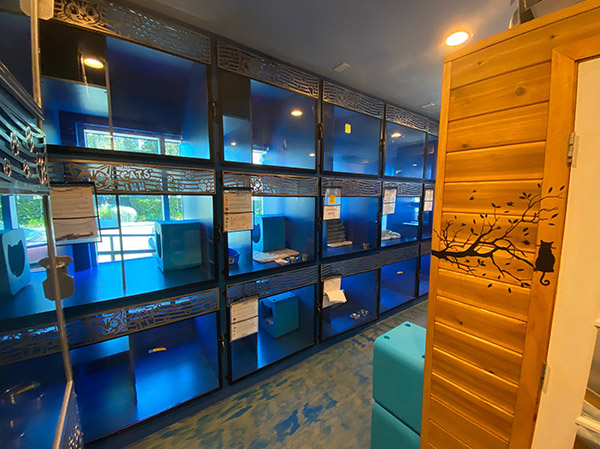
A standard boarding space typically provides a caged enclosure with basic amenities. A cat suite - as offered at The Cats' Inn - provides a larger, more home-like space with enrichment, climbing options, and design elements that reduce environmental stress. The behavioral benefit is not aesthetic: more vertical space and environmental complexity reduce the monotony that contributes to stress-related behaviors during extended stays.
Ready to See the Difference for Yourself?
If you have read this far, you are not looking for the nearest option. You are looking for the right one.
Tour The Cats' Inn's professional cat care facility at 880 Old County Rd, Belmont, CA 94002 - and see exactly where your cat would sleep, play, and spend their time while you are away. Because knowing is better than hoping.
As the recipient of the Best of San Mateo Area Best Place to Board Pets (Winner) award and recognition among the area's Best Cat Sitters, The Cats' Inn continues to set the standard for specialized feline care in the Bay Area.
Schedule your virtual tour at thecatsinn.net
About the Author
The owner and operator of The Cats' Inn has dedicated more than 30 years to providing exceptional cats-only boarding, grooming, daycare, and sitting services in Belmont, California. Under her leadership, The Cats' Inn has grown into one of the San Francisco Bay Area's most trusted destinations for feline care, featuring a 3,400-square-foot facility with themed playrooms, luxury accommodations, and specialized grooming services.
Her approach centers on personalized, low-stress care tailored to each cat's individual personality and needs. Under her leadership, The Cats' Inn has been recognized in the Best of San Mateo Area awards as Best Place to Board Pets (Winner), Best Cat Sitters (Winner), and Runner-Up for Best Place to Groom Animals, reinforcing its reputation as one of the Bay Area's leading feline care providers.
References
American Association of Feline Practitioners (AAFP) - Feline Environmental Needs Guidelines, covering behavioral welfare standards and environmental stressor identification in feline housing contexts.