
Why Cat Grooming Is More Complex Than Most Guides Admit (And What Actually Makes a Difference)
Professional cat grooming isn't just a bath and a brush-out. It's a discipline that requires reading feline body language in real time, using species-appropriate handling techniques, and understanding that a cat's stress response begins long before anyone picks up a comb. Done well, it protects coat health, catches early signs of skin issues, and builds the kind of handling tolerance that makes your cat's life easier for years.
Key Takeaways
- Cats have significantly thinner, more sensitive skin than dogs, which means the wrong tool or too much pressure can cause injury even with good intentions.
- Feline stress during grooming isn't a personality flaw. It's a predictable physiological response to restraint, unfamiliar scents, and sensory overload.
- A cats-only environment reduces ambient stress before the session even starts, because cats respond to the smell and sound of dogs even when no dog is visible.
- The first few professional grooming sessions set a behavioral pattern that's genuinely difficult to reverse if they go badly. Getting them right matters.
- Regular grooming catches early signs of matting, skin irritation, and parasite activity that are easy to miss during casual home handling.
- The Cats' Inn has been recognized for exceptional feline care, winning Best Place to Board Pets in the Best of San Mateo Area awards and being named Best Cat Sitter for three consecutive years, including this year. The Cats' Inn is also a runner-up for Best in the Bay, reflecting its long-standing reputation as one of the Bay Area's most trusted cats-only boarding facilities.
What Makes Cat Grooming Different From Everything You've Read About It
Most grooming content treats cats like small, difficult dogs. That framing is the core problem.
A cat's skin is considerably thinner and more elastic than a dog's. Clipper pressure that's routine on a Labrador can cause clipper burn or surface laceration on a Persian. Cats also thermoregulate differently, groom themselves as a stress-coping behavior, and experience physical restraint as a threat signal rather than a neutral inconvenience.
The grooming session doesn't begin when the groomer picks up the brush. It begins the moment your cat enters the building.
Scent is the first variable. A facility that handles dogs alongside cats carries ambient olfactory information that cats process as predator presence. That's not metaphorical. It's a documented stress pathway in feline neurology, and it means a cat who arrives already in a low-grade threat response is harder to handle, more reactive to touch, and more likely to associate grooming with something dangerous.
This is why cats-only environments aren't a marketing preference. They're a functional starting condition that changes the entire grooming experience before a single tool is used.
Is Your Cat Being "Difficult," or Is She Just Being Accurate?
Here's the part worth sitting with: a cat that resists grooming isn't being uncooperative. She's responding to her environment accurately.
Many grooming environments, including well-intentioned home grooming sessions, use restraint methods that directly activate the feline threat response. Scruffing, or gripping the loose skin at the back of the neck, is still widely practiced despite growing consensus among veterinary behaviorists that it triggers a fear-freeze state rather than genuine calm. A cat that goes still when scruffed isn't relaxed. She's physiologically overridden.
The American Association of Feline Practitioners (AAFP) has published low-stress handling guidelines that specifically address this distinction. Their framework separates compliance through fear suppression from genuine behavioral cooperation, and the difference matters across repeated sessions. A cat that learns grooming is survivable will tolerate it. A cat that learns grooming is threatening will escalate with each session until handling becomes genuinely dangerous.
Getting the first few professional sessions right isn't optional. It's the difference between a cat you can groom comfortably for fifteen years and one that requires sedation at the vet by age five.
What Professional Cat Grooming Actually Includes
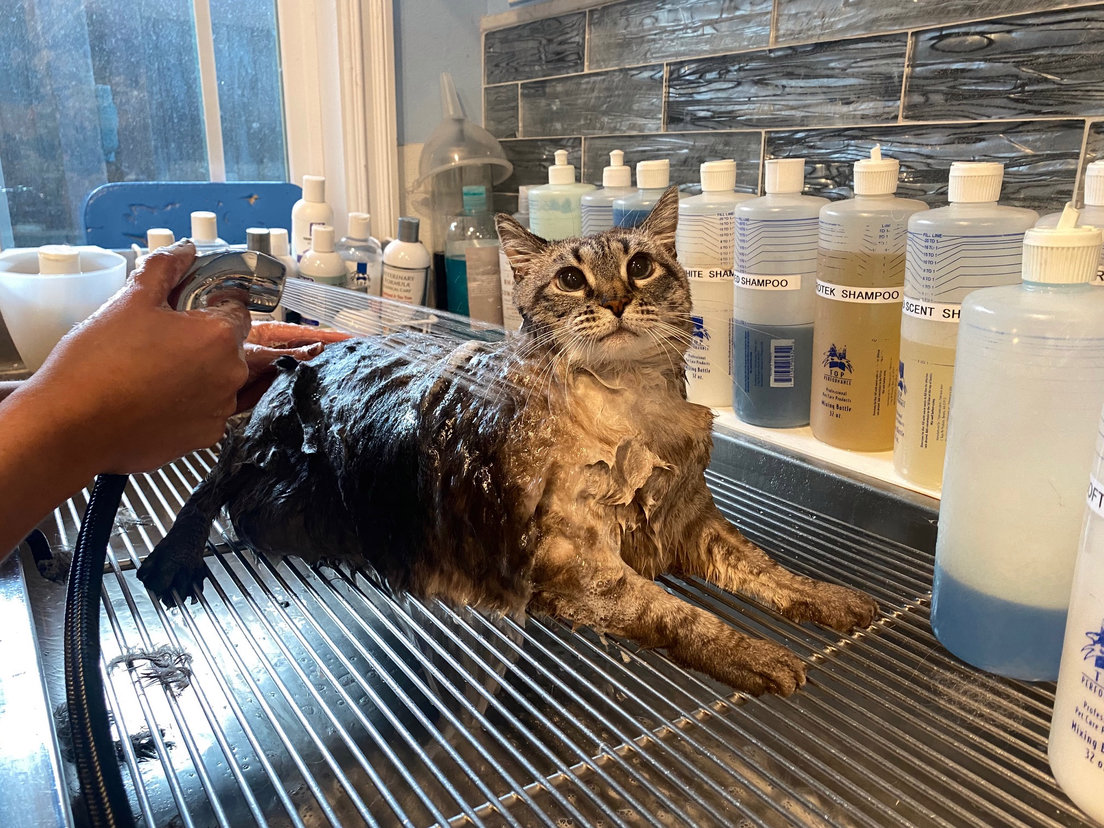
Professional grooming for cats typically covers coat brushing, deshedding treatments, bathing, temperature-controlled drying, nail trimming, ear cleaning checks, and sanitary trims. For longer-coated breeds, it often includes full haircuts or lion cuts to address matting that can't be brushed out.
At The Cats' Inn in Belmont, the spa packages are built specifically for cats, not adapted from a general pet grooming model. That distinction has real operational meaning. The drying equipment, table configuration, handling protocols, and session pacing are all calibrated for feline physiology, not borrowed from a dog grooming workflow.
Consider a typical scenario: a five-year-old domestic longhair who's never had professional grooming develops a mat behind one ear. The owner tries to work through it at home, the cat scratches and bites, and the mat tightens closer to the skin. By the time a groomer sees her, removal requires clippers near a sensitive area on an already-reactive cat. A trained feline groomer can manage it, but the session takes longer, requires more careful handling, and is far more stressful than it would have been with routine grooming established early.
That scenario is preventable. Routine professional grooming isn't cosmetic maintenance. It's preventive care that saves you the harder conversation later.
A Simple Framework for Knowing What Your Cat Actually Needs
Not every cat is ready for a standard grooming appointment, and booking the wrong session type can set back progress significantly. A tiered approach, informed by the AAFP's low-stress handling principles, helps you figure out where your cat fits before you book anything.
Tier 1: Standard Grooming. Your cat tolerates brushing at home without hissing or biting, accepts nail trims with mild resistance, and has no history of grooming-related aggression. Standard professional grooming is appropriate.
Tier 2: Modified Low-Stress Approach. Your cat resists brushing, vocalizes during nail trims, or has had a difficult grooming experience in the past. Look for a cats-only facility with documented low-stress handling protocols, and ask whether the groomer has feline-specific training. Shorter, more frequent sessions and gradual desensitization will serve her better than trying to accomplish everything in one visit.
Tier 3: Veterinary Consultation First. Your cat has scratched or bitten a groomer, has a history of trauma, has a medical condition affecting her skin or coat, or is significantly matted. A vet visit to assess whether mild sedation or anti-anxiety support is appropriate should come before any grooming session. Pushing through a Tier 3 appointment without that support doesn't just fail. It makes the next attempt harder.
This framework isn't a substitute for professional judgment. It tells you what kind of professional you need.
How Grooming Connects to Everything Else in Your Cat's Care
Grooming doesn't exist in isolation. It's one layer of your cat's overall health maintenance, and it surfaces information that other care settings miss.
A groomer working carefully through a coat will notice skin irritation, unusual lumps, flea dirt, or early-stage matting before any of it becomes a veterinary problem. This is one reason why facilities that offer grooming alongside boarding and medication administration provide more genuine continuity of care than single-service providers. The staff already knows your cat. They've seen her baseline.
If your cat is boarding at The Cats' Inn during your trip, adding a grooming session to her stay isn't just a logistical convenience. It means the people working with her coat already have a relationship with her, which reduces the stress variable in a way that a standalone grooming appointment at an unfamiliar place can't replicate. You can see how the facility is laid out, including the grooming and care areas, through The Cats' Inn's virtual tour.
Grooming Regularly vs. Skipping It: What You're Actually Comparing
This isn't a comparison between professional grooming and home grooming. It's a comparison between consistent coat and nail care and what accumulates without it.
Care Situation | With Regular Professional Grooming at The Cats' Inn | Without Consistent Grooming |
Coat condition | Detangled, deshedded, skin visible for health checks | Matting risk increases, especially in longhaired breeds |
Nail health | Trimmed on a predictable schedule | Overgrowth can cause nails to curl into paw pads |
Skin and parasite detection | Caught early during routine sessions | Often missed until symptoms appear |
Handling tolerance over time | Builds through repeated low-stress sessions | Worsens as avoidance and reactivity reinforce each other |
Stress during vet visits | Lower, because restraint and handling feel familiar | Higher, because the cat has no positive handling history |
Emergency grooming needs | Rarely required | More likely, more expensive, and harder on the cat |
The cost of skipping routine grooming isn't zero. It accumulates as harder sessions, more reactive responses, and occasional emergency interventions that are more distressing and more expensive than the maintenance visits would ever have been.
When Professional Facility Grooming Isn't the Right First Step
Honest assessment matters here. Facility grooming isn't the right starting point for every cat in every situation.
If your cat has a severe anxiety disorder, a recent surgical site, or a condition that makes handling painful, grooming should wait until your vet clears it. A good groomer will tell you exactly that. The goal is never to push through a session at the expense of the cat's wellbeing.
Cats with significant trauma history or extreme fear responses may need behavioral support before facility grooming is realistic. That's not a failure. It's an accurate read of where the cat is and what she needs first.
What's worth reconsidering, though, is the assumption that a cat who's difficult at home will always be difficult everywhere. Cats-only environments, feline-trained handlers, and low-stress protocols change the equation in ways that home grooming or a general pet salon simply can't match. A cat who seems ungroom-able in one setting can do genuinely well in another. That's not wishful thinking. It's what happens when the environment is actually designed for her.
Frequently Asked Questions
How often does my cat actually need professional grooming?
It depends on coat length and how well your cat maintains herself. Shorthaired cats who groom effectively may only need professional attention two to four times a year, mainly for nail trims and deshedding. Longhaired breeds like Persians or Maine Coons typically need more frequent sessions to stay ahead of matting. A groomer who specializes in cats can assess your cat's specific coat and recommend a realistic schedule based on what they actually see.
My cat hates being touched. Can she still be professionally groomed?
Probably yes, but the approach matters. A cat who resists handling at home isn't automatically a candidate for a standard session. Look specifically for a groomer with feline-focused training and documented low-stress handling methods, and ask whether they're willing to work in shorter sessions if that's what your cat needs. The first appointment should be as much about building tolerance as completing a service.
Is it safe to bathe a cat?
Yes, when it's done with cat-specific products and appropriate drying methods. Cats have a different skin pH than dogs, so using dog or human shampoo can cause irritation or strip natural oils. The drying process is just as important as the bath itself. High-heat dryers can overheat or significantly stress cats. Professional facilities that focus on feline care use temperature-controlled drying and products formulated for cats. You can explore what a feline-appropriate bath looks like through The Cats' Inn's bubble bath services.
What's the difference between a lion cut and a regular trim?
A lion cut removes most of the body coat, leaving fur on the head, lower legs, and tail tip. It's typically used for cats with severe matting that can't be brushed out, or for longhaired cats whose owners want to reduce coat management during warmer months. It's not appropriate for every cat and it's not a substitute for regular brushing going forward. A feline groomer can tell you honestly whether it's a reasonable option for your cat's specific coat and temperament.
Will grooming stress my cat out more than just leaving her coat alone?
A poorly handled session in the wrong environment can. A well-handled session in a cats-only facility typically won't. Cats who are introduced to professional grooming gradually, using low-stress techniques, generally show lower stress responses over repeated visits, not higher ones. The argument for skipping grooming usually comes from bad early experiences in unsuitable settings, not from grooming itself.
What vaccines does my cat need before a grooming or boarding appointment?
Most professional cat care facilities require proof of current FVRCP (feline viral rhinotracheitis, calicivirus, and panleukopenia) and rabies vaccinations. FVRCP is especially relevant in any environment where cats from different households share space, since upper respiratory viruses spread easily even with careful cleaning protocols. Review The Cats' Inn's requirements and amenities page for current vaccination requirements before your appointment.
Should I schedule grooming before or during a boarding stay?
Scheduling a grooming session during a boarding stay is often the lower-stress option. Your cat is already in the environment, already familiar with the staff, and doesn't have to travel twice. If you schedule grooming right before a boarding drop-off and your cat finds it stressful, she'll arrive at boarding already in a heightened state, which makes settling in harder. Talk to The Cats' Inn about timing when you book. The goal is always to set her up for the calmest possible experience.
Your cat doesn't need to dread grooming. She needs a groomer who understands why she might, and who knows how to work with that response rather than push past it.
If you're in the San Mateo or Belmont area, contact The Cats' Inn to talk through what grooming approach suits your cat's temperament and coat before you book. Getting the first session right is worth the conversation.